
Article
When we hear about a cybersecurity incident involving a bank, our first concern is usually money. Are customer accounts safe? Have transactions been affected? Is online banking operating normally?
But there is another side of cybersecurity
that deserves equal attention: the protection of personal information. The
recent State Bank of India (SBI) data exposure incident reminds us why
safeguarding customer information matters even when banking operations continue
normally.
On 21 October 2026, SBI disclosed that a
preliminary review had identified 3,897 customer records containing personally
identifiable information (PII) among approximately 3.75 lakh records found on
the dark web. The bank reassured customers that their balances were safe and
core operations were not materially affected. The broader question remains:
what risks arise when personal information is exposed?
What Happened in the SBI Data Exposure Incident?
According to SBI’s disclosure, the bank received alerts on 16 October 2026 from its threat intelligence provider, the Defence Cyber Agency and CERT-In regarding suspected customer information exposed on the dark web. A preliminary review identified 3,897 customer records containing PII among approximately 375,000 records examined.
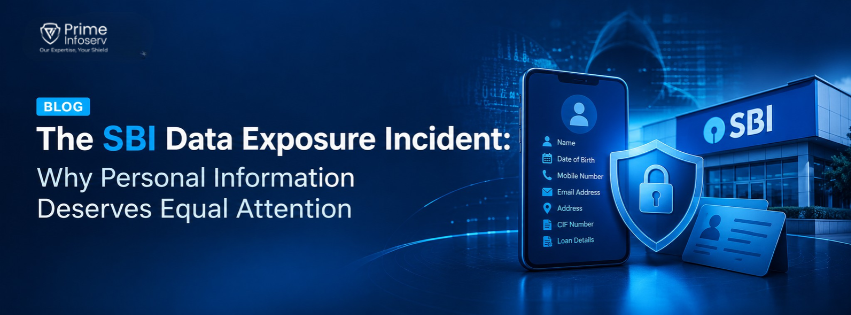
The reportedly exposed information included:
· Names and dates of birth
· Registered mobile numbers, email addresses and residential addresses
· Gender and branch identifiers
· Customer Information File (CIF) identifiers
· Loan-related lead IDs and associated metadata
The figure of 3,897 represents an initial
finding, not necessarily the final number affected. The authenticity, source
and full extent of the exposure remain under investigation. SBI has initiated
its incident response process and engaged an independent CERT-In-empanelled
cybersecurity agency.
SBI’s Official Clarification
SBI stated that the incident had affected a very small number of customers relative to its overall customer base. It reported no material impact on its IT systems, core banking operations, financial performance or business continuity, and assured customers that balances were safe.
That distinction matters. Exposure of
personal information does not automatically mean an attacker accessed banking
credentials, account funds or transaction systems. Yet personal data can still
create security risks outside the bank’s core platform.
Why Personal Information Matters to Cybercriminals
Imagine receiving a call from someone claiming to work at your bank. They already know your name, date of birth, registered mobile number and details relating to a loan enquiry. The call may appear convincing even when it is fraudulent.
Stolen or exposed personal details may support:
· Targeted phishing through personalised email and text messages
· Impersonation of banking representatives using genuine customer details
· Identity-related fraud by combining information across sources
· Social engineering intended to obtain credentials or induce unauthorised transfers
An attacker does not necessarily need a
password to initiate a scam. Sometimes a few accurate personal details are
enough to establish false credibility.
What Organisations Can Learn
Security programmes have traditionally emphasised firewalls, endpoints, networks, vulnerabilities and applications. These controls are essential, but they do not replace visibility into the personal data collected, processed, stored and shared across the business.
Organisations should be able to answer
where customer data resides, who can access it, what vendors receive it,
whether bulk access or transfers would be detected and how quickly a suspected
exposure could be investigated. Data can reside across CRMs, loan-processing
systems, cloud services, third-party applications and endpoints.
DPDP Act: Readiness Beyond Compliance Checklists
India’s Digital Personal Data Protection Act, 2023 and the DPDP Rules, 2025 raise the importance of privacy safeguards, accountability and breach response. Section 8(5) addresses reasonable security safeguards; Section 8(6) addresses notification to the Data Protection Board and affected individuals, with Rules 6 and 7 providing further details.
As of 22 October 2026, these substantive requirements are not yet in force under the phased implementation schedule. Existing applicable banking, cybersecurity and CERT-In requirements continue independently. It would be incorrect to conclude from the public disclosure alone that SBI violated the DPDP Act.
Even so, businesses can prepare now by
mapping data flows, defining authorised access, reviewing retention and vendor
controls, and rehearsing breach detection, investigation and communication.
Five Practical Lessons for Organisations
1. Know where personal data exists
Begin with data discovery, inventory and classification. Protecting information is difficult when its location and flow are unknown.
2. Limit access to sensitive information
Apply least privilege, periodic access reviews and suitable authentication to employees, applications and third-party service providers.
3. Monitor unusual data access and movement
Look beyond malware alerts to bulk exports, unusual queries and unauthorised transfers. SOC monitoring, data loss prevention and related controls can help.
4. Assess third-party exposure
Review service providers, integration points, contracts and data-sharing practices. The source of the SBI exposure has not been established, so this is a general lesson rather than an explanation of this incident.
5. Practise incident response
Set clear responsibilities for escalation,
containment, forensic investigation, regulatory assessment and customer
communication. Tabletop exercises can reveal weaknesses before an incident.
What Customers Can Do
· Never share passwords, PINs or OTPs over a call or message.
· Avoid urgent KYC or account-update links received unexpectedly.
· Verify suspicious communications through official banking channels.
· Enable transaction alerts and review account activity.
· Report suspected fraud promptly through the bank’s official channels.
A caller knowing your name or date of birth
does not prove that they represent your bank.
Final Thoughts: Protecting Trust
SBI’s investigation is continuing, and it is too early to draw conclusions about the root cause or final impact. Its public clarification and activation of incident response are meaningful developments. Meanwhile, the wider lesson is clear: customer trust rests not only on protected balances and functioning services but also on responsible stewardship of personal information.
Cybersecurity is not only about protecting
systems. It is also about protecting the people behind the data.