
Article
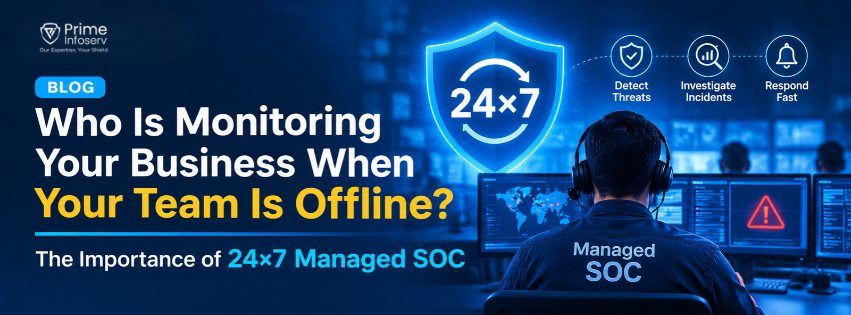
Your employees may log out at the end of the day, but cyber threats never do. Discover why 24×7 Managed Security Operations are essential for protecting modern businesses.
Introduction: Cyber Threats Don't Wait for Business Hours
Imagine this: Your IT team has finished work for the day. Employees have logged out, systems are running normally, and your business operations appear secure.
But at 2:30 AM, an attacker attempts to access your company's network using compromised credentials. Suspicious activity begins on a critical server. Sensitive files are accessed, and an unusual data transfer starts taking place.
Who notices it?
Who investigates the activity?
And more importantly, who responds before the incident becomes a major security breach?
For many organisations, the answer is concerning: nobody may be actively monitoring the environment at that moment.
Cyberattacks do not follow office hours. Ransomware, phishing, unauthorised access, malware infections and suspicious network activity can happen at any time. This makes continuous security monitoring an essential part of modern business protection.
This is where a 24×7 Managed Security Operations Centre (Managed SOC) becomes important.
What Is a Managed SOC?
A Managed Security Operations Centre (SOC) is a dedicated security monitoring and response function that continuously monitors an organisation's IT environment to identify, investigate and respond to potential cyber threats.
Unlike traditional security arrangements that depend entirely on an internal IT team, a Managed SOC combines security technologies, skilled analysts, threat intelligence and established incident response processes.
A Managed SOC typically provides:
24×7 Security Monitoring: Continuous monitoring of networks, endpoints, servers, applications and cloud environments.
Threat Detection: Identification of suspicious activities, unusual login patterns and potential cyberattacks.
Security Incident Investigation: Analysis of alerts to distinguish genuine threats from routine system activity.
Incident Response Coordination: Timely escalation and response to confirmed security incidents.
Threat Intelligence: Monitoring emerging threats, attacker techniques and indicators of compromise.
Security Reporting: Regular visibility into security incidents, risks, trends and response activities.
The objective is simple: detect potential threats early, reduce the time taken to respond and minimise the impact on business operations.
Why Is 24×7 Security Monitoring Important?
Many organisations invest in firewalls, antivirus software, endpoint protection and other cybersecurity tools. However, deploying security tools does not automatically mean that an organisation is continuously protected.
Security tools generate alerts, but those alerts need to be monitored, investigated, prioritised and acted upon.
Here are some reasons why round-the-clock security monitoring matters.
1. Cyberattacks Can Happen Outside Office Hours
Attackers often take advantage of periods when security teams have limited availability.
After-hours periods, weekends and public holidays can create monitoring gaps if an organisation relies only on a business-hours IT team.
A 24×7 Managed SOC helps ensure that suspicious activity receives attention even when the organisation's regular employees are offline.
2. Faster Threat Detection Can Reduce Business Impact
The longer a cyber threat remains undetected, the more opportunity an attacker may have to compromise systems, access sensitive information or disrupt operations.
Continuous monitoring helps security analysts identify suspicious behaviour and investigate potential incidents earlier.
Early detection can support faster containment and reduce the potential damage caused by an attack.
3. Security Alerts Need Human Investigation
Modern security tools can generate thousands of alerts. However, not every alert represents a genuine security incident.
Without proper investigation, critical warnings may get lost among routine notifications and false positives.
SOC analysts evaluate alerts, correlate security events and prioritise incidents based on their severity and potential business impact.
4. Internal IT Teams Cannot Monitor Everything Alone
Internal IT teams already manage infrastructure, applications, user access, troubleshooting, maintenance and business technology requirements.
Expecting the same team to provide uninterrupted security monitoring can stretch available resources.
A Managed SOC provides access to specialised security analysts and established monitoring processes without requiring an organisation to build an entire SOC operation independently.
5. Better Visibility Across the IT Environment
Businesses increasingly operate across on-premises infrastructure, cloud platforms, remote endpoints, applications and third-party environments.
Monitoring these different environments separately can create visibility gaps.
A Managed SOC helps bring security information together, enabling analysts to identify suspicious patterns across multiple systems.
What Happens When Your Business Has No After-Hours Security Monitoring?
Consider a few common scenarios.
Scenario 1: Suspicious Login at Midnight
An employee's credentials are compromised, and someone attempts to access the organisation's network from an unusual location.
Without continuous monitoring, the activity may remain unnoticed until the next working day.
Scenario 2: Ransomware Activity During the Weekend
Malicious software begins encrypting files on a business server late on Saturday night.
If the activity is not detected and investigated promptly, the incident may affect multiple systems before employees return.
Scenario 3: Unusual Data Transfer After Office Hours
A compromised account starts transferring large volumes of sensitive business information outside normal working hours.
Without proper monitoring, the organisation may not identify the unusual activity until significant data has already been exposed.
Scenario 4: Suspicious Privileged Account Activity
An attacker attempts to misuse an administrator account to access critical infrastructure.
A continuous monitoring function can help identify unusual privileged access patterns and escalate the activity for investigation.
These scenarios highlight an important reality: having cybersecurity tools is not the same as having someone actively monitoring and responding to security threats.
Managed SOC vs Traditional In-House Security Monitoring
Both in-house SOC teams and Managed SOC services can support organisational security. The right approach depends on available resources, infrastructure, risk exposure and operational requirements.
| Parameter | Traditional IT Monitoring | Managed SOC |
|---|---|---|
| Monitoring hours | Often limited to working hours | 24×7 monitoring, subject to service scope |
| Security expertise | Depends on internal resources | Access to specialised security analysts |
| Threat investigation | May depend on IT availability | Dedicated security investigation processes |
| Alert management | Often handled alongside IT tasks | Security-focused alert analysis and prioritisation |
| Threat intelligence | Depends on available capabilities | Can integrate threat intelligence |
| Incident escalation | Internal escalation procedures | Defined escalation paths and response workflows |
| Infrastructure investment | Internal tools and staffing | Managed service model |
A Managed SOC does not replace an organisation's internal IT team. Instead, it strengthens its security capabilities by providing dedicated monitoring, investigation and escalation support.
What Should You Look for in a Managed SOC Provider?
Choosing a Managed SOC provider is an important security decision. Organisations should evaluate more than just the technologies being offered.
Here are some essential factors to consider:
1. Genuine 24×7 Monitoring
Confirm whether the provider offers continuous, actively staffed monitoring or simply automated alerts and on-call support.
2. Skilled Security Analysts
Technology alone cannot investigate every security incident. Look for experienced analysts who can understand suspicious behaviour, investigate alerts and support incident handling.
3. Clear Incident Escalation Procedures
Ask how critical incidents are escalated, who gets notified and how quickly the organisation is informed.
4. Defined Response SLAs
Understand the provider's acknowledgement, investigation and escalation timelines. Also clarify which containment and remediation activities are included in the service.
5. SIEM and SOAR Capabilities
A capable SOC should be able to collect and correlate security events through Security Information and Event Management (SIEM) and automate appropriate workflows through Security Orchestration, Automation and Response (SOAR).
6. Threat Intelligence Integration
Threat intelligence can help security teams identify known malicious indicators, understand emerging attack patterns and improve detection capabilities.
7. Meaningful Security Reports
Regular reports should provide more than alert counts. They should communicate security incidents, investigation outcomes, risk trends, response performance and recommended improvements.
Introducing TRINEXA SOC: A Unified Approach to Security Operations
Managing cybersecurity across multiple tools, infrastructure environments and security processes can become complicated.
Security teams need visibility, coordination and actionable information to manage threats effectively.
TRINEXA SOC by Prime Infoserv is designed as a unified security operations command centre that brings key security monitoring and management capabilities together through a single dashboard.
Instead of managing disconnected security information across multiple platforms, organisations can use a centralised operational view to improve security visibility and coordination.
TRINEXA brings together capabilities such as:
Unified Security Visibility
A centralised dashboard helps bring together important security information and operational activities, making it easier to understand the organisation's security posture.
SIEM Integration
Security Information and Event Management capabilities help collect, correlate and analyse security events from different sources to support threat detection and investigation.
SOAR Capabilities
Security Orchestration, Automation and Response helps streamline repetitive security workflows and supports faster, more consistent incident handling.
Threat Intelligence
Threat intelligence capabilities help security teams evaluate suspicious indicators and understand potential threats targeting the organisation.
AI-Integrated Security Operations
AI-integrated capabilities can support security analysis, information correlation and operational efficiency, helping analysts focus on meaningful security activities.
Compliance and Security Management
TRINEXA also brings together capabilities supporting frameworks and requirements such as DPDP, SEBI CSCRF and ISO 27000-series requirements, helping organisations coordinate security and compliance activities.
The objective is to bring security operations closer together: better visibility, improved coordination and more informed security decisions.
Explore TRINEXA SOC: https://trinexasoc.com/
How Prime Infoserv Helps Organisations Strengthen Their Security Operations
A security platform is only one part of an effective cybersecurity strategy. Organisations also need experienced professionals, defined processes and continuous operational support.
Prime Infoserv combines cybersecurity expertise with managed security operations to help organisations strengthen their security posture.
Its managed security approach focuses on:
Continuous 24×7 monitoring through dedicated security operations resources.
Security event analysis and threat investigation.
Incident identification, escalation and coordination.
SIEM, SOAR and threat intelligence capabilities.
Endpoint, network and infrastructure security visibility.
Regular security reporting and operational insights.
Support for improving security controls and managing cyber risks.
With TRINEXA SOC supporting a unified security operations approach, Prime Infoserv aims to help organisations bring people, processes and security technology together.
Whether you are a financial institution, enterprise, government organisation, utility provider or growing business, having a structured security monitoring and response capability can make a significant difference to your cyber resilience.
Is Your Business Really Secure When Everyone Is Offline?
Ask your IT and security teams these five questions:
Who monitors our network and critical systems after office hours?
Who investigates suspicious login attempts and unusual system activity at night?
How quickly are critical security incidents escalated?
Do we have visibility across endpoints, servers, networks and cloud environments?
Can management access meaningful reports about security incidents and response activities?
If you do not have clear answers, it may be time to review your organisation's security monitoring strategy.
Cybersecurity is not just about preventing attacks. It is also about identifying suspicious activity, responding effectively and maintaining visibility when business operations are not active.
Conclusion: Your Security Should Never Clock Out
Your employees may work eight or nine hours a day, but your digital infrastructure operates around the clock.
A firewall cannot investigate every suspicious event. An antivirus solution cannot replace a dedicated incident response process. And an IT team cannot always monitor every security alert while managing regular business operations.
A 24×7 Managed SOC helps bridge this gap by combining continuous monitoring, security expertise, threat intelligence and incident response coordination.
With Prime Infoserv's managed security capabilities and TRINEXA SOC's unified security operations approach, organisations can work towards stronger security visibility and more structured threat management.
Because when your team logs out, your security monitoring should not.
Ready to Strengthen Your 24×7 Security Monitoring?
Don't wait for a security incident to discover the gaps in your monitoring strategy.
Connect with Prime Infoserv to explore Managed SOC services and discover how TRINEXA SOC can support a more unified approach to security operations.
Website: https://www.primeinfoserv.com/
TRINEXA SOC: https://trinexasoc.com/
Email: info@primeinfoserv.com
Phone: +91 9147712576
Prime Infoserv – Your Partner in Building Stronger Cybersecurity Operations.