

Article
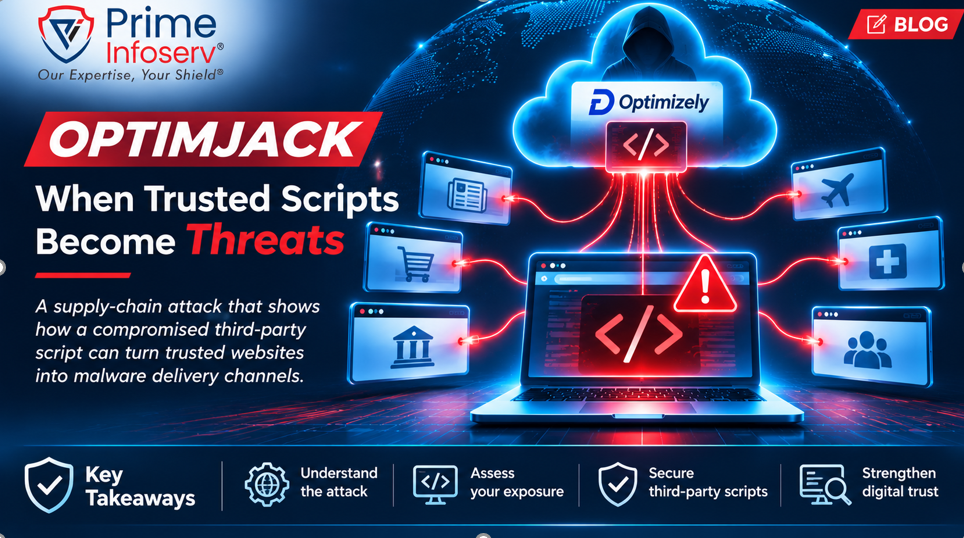
A JavaScript supply-chain incident illustrates why organizations must monitor the code their customers’ browsers execute—not just the servers they own.
The invisible risk inside a trusted website
A customer opens a familiar news site, bank portal, or technology platform. The page looks legitimate, the HTTPS connection is secure, and nothing appears unusual. Yet the browser may be executing code supplied by third parties for analytics, experimentation, advertising, or personalization. If that code is compromised, the visitor can be exposed without the website itself being directly breached.
The reported OPTIMJACK campaign brought this risk into focus. Researchers linked malicious JavaScript delivered through Optimizely’s Web Experimentation ecosystem to at least 178 organizations. The incident is a powerful reminder: third-party scripts are part of an organization’s attack surface.
What happened in OPTIMJACK?
Optimizely Web Experimentation helps companies test and personalize website experiences. Websites integrate scripts from the service, and visitors’ browsers execute that code as part of the page experience. According to incident reporting, attackers abused a weakness in the platform’s signup or project workflow to place malicious JavaScript into affected projects. The resulting scripts were served through a trusted third-party infrastructure.
This is the defining characteristic of a software supply-chain attack: compromising a shared dependency can create exposure across many downstream organizations. The reported count of affected organizations should not be interpreted as proof that every visitor was infected or that every named organization suffered a confirmed data breach.
What could the injected JavaScript do?
Cryptocurrency address substitution
Replace copied wallet addresses with attacker-controlled destinations, potentially diverting transfers.
Payment-card skimming
Collect payment details from vulnerable browser forms, creating fraud and compliance exposure.
Cookie and screenshot collection
Capture accessible session information and on-screen content that may support account compromise or intelligence gathering.
Mobile exploit delivery
Attempt to direct vulnerable Apple devices toward exploit chains. An attempted exploit is not equivalent to a confirmed successful compromise.
Why conventional perimeter controls are insufficient
Firewalls, endpoint protection, MFA, and server-side VAPT remain necessary. However, a browser can load authorized code from a third-party domain after the user reaches an otherwise secure website. A TLS certificate validates the encrypted connection; it does not establish that the delivered JavaScript is trustworthy. Organizations need visibility into what code executes in the customer browser, what data it can access, and where it sends information.
Seven controls every organization should prioritize
· Maintain a live inventory of all external scripts, their owners, purposes, and pages of execution.
· Monitor script changes and browser-side network destinations for unexpected behavior.
· Deploy a carefully tested Content Security Policy (CSP), including reporting and restrictive connect-src directives.
· Use Subresource Integrity (SRI) for suitable static scripts; supplement it with monitoring for dynamic scripts.
· Minimize third-party script privileges and isolate high-risk functions where technically feasible.
· Assess marketing technology, tag managers, and experimentation providers in third-party risk reviews.
· Prepare incident playbooks covering supplier alerts, browser telemetry, exposure analysis, and customer communication.
What should Optimizely customers do?
Review the vendor’s incident communication and confirm whether your organization’s projects were affected. Inspect project JavaScript, recent changes, account and API access, and available web security telemetry. Coordinate with the vendor on remediation and independently assess any customer exposure. Remediation of the supplier platform reduces future risk but does not automatically establish whether earlier visitors were affected.
Implications for Indian businesses and DPDP readiness
Browser-side collection of personal data can raise privacy and contractual questions, especially where customer identifiers, payment details, or session information are involved. Indian organizations should include third-party web scripts in data-flow mapping, supplier assessments, incident response, and applicable DPDP readiness work. Whether notification or other obligations apply depends on the facts, the data involved, and the law in force at the relevant time.
How Prime Infoserv supports stronger digital trust
Prime Infoserv helps organizations strengthen application and ecosystem security through web application security assessments and VAPT, third-party risk reviews, security architecture and configuration assessments, incident response readiness, and data protection advisory. These services can help teams identify unmanaged dependencies, evaluate browser-side risks, and prioritize practical safeguards.
Frequently asked questions
Does this mean all 178 organizations were breached?
No. Reported downstream exposure through a third-party script does not, by itself, establish a direct breach of every organization or confirmed compromise of all visitors.
Can Content Security Policy stop every malicious third-party script?
No. CSP can constrain script sources and data connections, but an explicitly trusted malicious script may still execute. CSP works best alongside monitoring, least privilege, and other controls.
Is Subresource Integrity suitable for all third-party JavaScript?
No. SRI is most practical when the resource content is stable and a known hash can be pinned. Frequently changing experimentation scripts may need alternative integrity and behavioral controls.
What is the main lesson for CISOs?
Treat client-side code and supplier integrations as security-critical assets. Know what runs in customer browsers, detect changes, and rehearse response to supplier-originated incidents.
Final perspective
OPTIMJACK is not only a story about
malicious JavaScript. It is a lesson in inherited trust. A secure application
can still expose customers through a compromised external dependency. Digital
trust requires continuous verification of the entire experience—not just the
infrastructure inside the enterprise boundary.
Secure your applications. Assess your digital dependencies. Protect customer trust.
Prime Infoserv Pvt. Ltd. | info@primeinfoserv.com
- third-party JavaScript security; client-side security; Optimizely incident; website supply-chain ris